How to Validate an App Idea Before You Build It (2026)
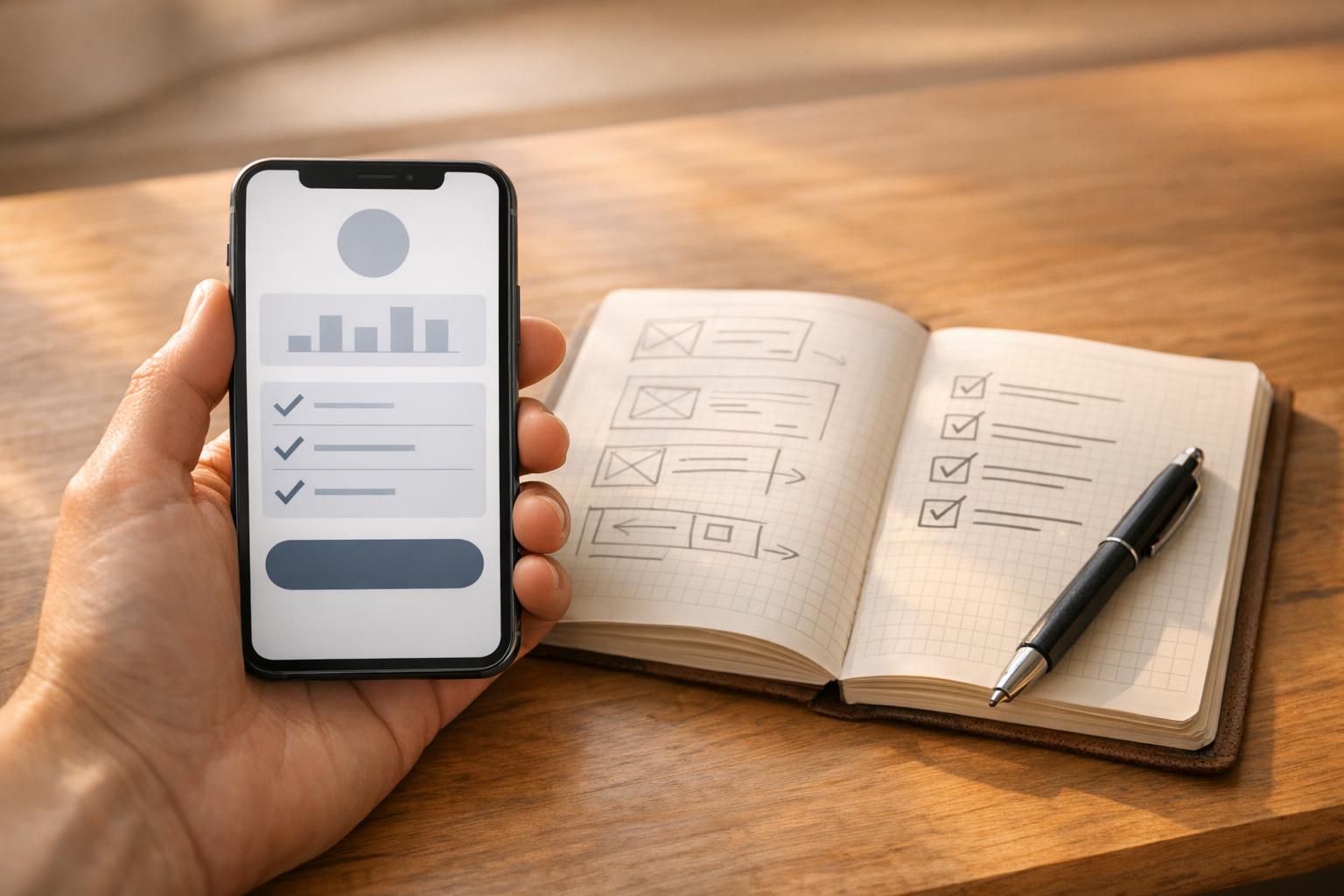
Short answer: test an app idea before building it by checking that one specific person needs it, that it replaces something people already put up with, and that someone would pay for it today. Search the App Store like a customer, look for the complaint online, then build a rough version one and use it yourself for a week.
Most app ideas die in one of two ways. Either they sit in someone's notes app for three years and never get built, or they get built at great expense for a market that turns out not to exist.
Validation is how you avoid both. It isn't market research, and it doesn't need a budget; it's an hour of honest checking that tells you whether the thing in your head is a business, a hobby, or a distraction. Here's how to do it properly in 2026, when building the app itself has become the cheapest part of the process.
Six signs an app idea is actually good
Before any research, hold your idea against these. They're uncomfortable on purpose.
1. One specific person needs it, not "everyone"
"Everyone will use it" is the most common thing people say about a doomed idea. If it's for everyone, it's for no one: you can't write the App Store listing, you can't picture the first user, and you can't decide what to leave out.
A quoting app for plumbers beats a social app for humans. Narrow is not a limitation; it's the only thing that makes the first hundred users findable.
2. It works with its very first user
Some apps are useful the moment one person opens them: a tracker, a calculator, a log, a quoting tool. Others need a crowd before they do anything at all: marketplaces, social feeds, anything with "community" in the pitch.
The second kind can absolutely work, but they starve first. If your idea needs 10,000 people to be useful to one person, you're not validating an app, you're validating a launch strategy.
3. It replaces something people already tolerate
The best app ideas usually replace a spreadsheet, a paper form, a WhatsApp thread, or a notebook in a van. People are already paying for those things with their time and their irritation, which is a far better signal than enthusiasm about a novel idea.
Boring problems have budgets. Novel problems have compliments.
4. The name alone explains it
"Van Mileage Log." "Wedding Seat Planner." "Deadlift PR Tracker." If someone understands the app from the name, your App Store listing does its job in half a second and your marketing writes itself.
If you need a paragraph to explain it, you'll need that paragraph every single time: in the store, in ads, on TikTok, in conversation. That's a tax you pay forever.
5. Someone would pay £5 for it today
Not "eventually, with ads." Today. Picture a specific human (a named plumber, a named gym-goer, your sister-in-law) and ask whether they'd pay a fiver right now to have it on their phone.
If you can't imagine one person paying, volume won't rescue you. Free apps with ads need enormous scale before they earn anything; paid utilities need a few hundred people who genuinely needed the thing.
6. You'd ship an embarrassing version one
Every successful app on the App Store started worse than it is now. If your plan requires the app to be finished and polished before anyone sees it, you're not planning a launch, you're planning a delay.
Version one is a question you ask the market, not an answer you deliver to it.
Five free validation checks you can do in an hour
Passed the six signs? Now go and look for evidence outside your own head. None of this costs money.
Check 1: Search the App Store like a customer
Search the words a real user would type, not your clever product name. Then look for three things:
- Does it already exist? Good. Competition proves demand. The absence of any competitor is more often a warning than an opportunity.
- What do the 2- and 3-star reviews say? This is the single richest source of product direction on the internet. People describing exactly what an existing app gets wrong are describing your feature list.
- When were the top apps last updated? A category full of apps last touched two years ago is a category with a gap in it.
Check 2: Check whether anyone is searching for it
Use Google Trends and Google's Keyword Planner (free with an Ads account) to see whether people search for the problem you're solving. You're not looking for millions of searches; a few thousand a month for a specific phrase is plenty for a niche utility.
Search the problem, not your solution: "how to track van mileage", not "mileage app".
Check 3: Find the complaint in the wild
Go where your specific person already talks. Reddit, Facebook groups, trade forums, Discord servers. Search the problem in your own words and read what comes back.
You're looking for people complaining about the current way of doing it: those complaints are your validation, and later they're your marketing copy. If nobody anywhere has ever complained about the problem, either you've found something genuinely new, or the problem isn't one.
Check 4: The £5 test, out loud
Describe the app to five people who match your target user. Not friends being polite, actual target users. Then ask the only question that matters: would you pay £5 for this?
Watch what happens after they say yes. Do they ask when it's ready? Do they ask for a feature? Do they tell you about their current workaround in detail? Those are buying signals. Vague praise ("Yeah, that sounds cool") is a no.
Check 5: Build version one and use it yourself for a week
This is the check that used to be impossible, and it's now the most useful one. Building a working app used to cost thousands of pounds and take months, which is exactly why validation had to be theoretical.
In 2026, you can describe your idea in plain English and have a real native iPhone app in minutes, then put it on your own phone and see whether you open it. A week of using your own app tells you more than a month of research: which screens you actually need, what's missing, and whether the idea survives contact with a normal Tuesday.
If you built it and you don't open it, that's a result. It cost you an hour instead of £15,000.
What the big indie apps validated before they built
The most-cited indie successes of recent years all did some version of this, publicly.
Puff Count, a quit-vaping app reported by its founder to reach around $40,000 a month, started with market research rather than inspiration: its creator noticed quit-smoking apps performing well, checked the demand data, and built the vaping equivalent. He isn't a developer. The validation came first, the build was outsourced.
QUITTR was built by a teenager who had watched a specific community discuss a specific problem at length before writing a line of SwiftUI. Version one reportedly took about ten days.
Cal AI, launched by a 17-year-old and later reported by TechCrunch to have passed 15 million downloads before being sold to MyFitnessPal, entered a category, calorie tracking, that was famously crowded. The founder validated a specific frustration inside a proven market: that logging food by hand is tedious, and a photo would be faster.
Notice the pattern. None of them invented a new category. All of them found an existing, provable frustration and made it less annoying.
Four validation mistakes to avoid
- Asking friends and family. They're answering a different question ("do you like me?") and they'll all say yes.
- Building for "everyone". See sign one. Generic apps are unmarketable and unfinishable.
- Waiting for certainty. Validation reduces risk; it never removes it. At some point the only remaining test is shipping.
- Confusing interest with intent. A hundred likes on a post is not a hundred customers. "I'd definitely download that" is not a payment.
The cheapest validation is a real app on your phone
Every check above is a way of guessing well. The reason validation used to matter so much is that building was expensive: you had to be nearly certain before spending £15,000 and three months.
That maths has changed. If you can describe your app in a sentence and have a real, native iPhone app running on your own phone the same day, the fastest validation available is simply to build it and live with it for a week.
Describe your idea to Orchard and it generates a real native SwiftUI app (not a web wrapper, not a mockup) that you can install on your own iPhone and actually use. If it survives a week on your home screen, you've validated it better than any survey could. If it doesn't, you've learned that in an afternoon for the price of an afternoon.
Next: How much does it cost to build an iPhone app in 2026? and How to build an iPhone app from scratch and actually make money.
Want a real native iPhone app, not a web wrapper? Orchard turns a plain-English prompt into genuine Swift and ships it to the App Store, no code required.
Build your app from a single prompt
Describe your idea and Orchard writes a real, native SwiftUI iPhone app, or an iPhone + Android app you can open on your phone in seconds. Free to start, no code, no Mac.
Generate your app →